
Workforce Harness · AI Adoption · 6 min read
Your best employee is the first to reject AI.
Give six people the same AI tool and the one who knows your business best will be the first to walk away from it. That is not a problem with her. It is the problem with how AI is being handed out.
By Gareth de Bruyn, Founder & Chief Architect, deBCor Engineering. SAP veteran of thirty years.
Every enterprise is considering AI. Some have run a pilot. A few have licensed seats. Most are somewhere between a vendor demo and a board question, and the board question is the same everywhere: what will this do for us, and what will it cost?
In most companies, the answer is being written before the first tool is deployed. Efficiency. Two workers using AI can replace five. The slide practically writes itself.
But how do you actually get there? The plan I see most often is to bet on a few AI-enabled powerhouses — the people who take to the tools naturally — while the rest of the team waits for training to catch up. It assumes the ones excited to experiment will be the ones who carry the company. There is another way to look at it.
Who would you cut?
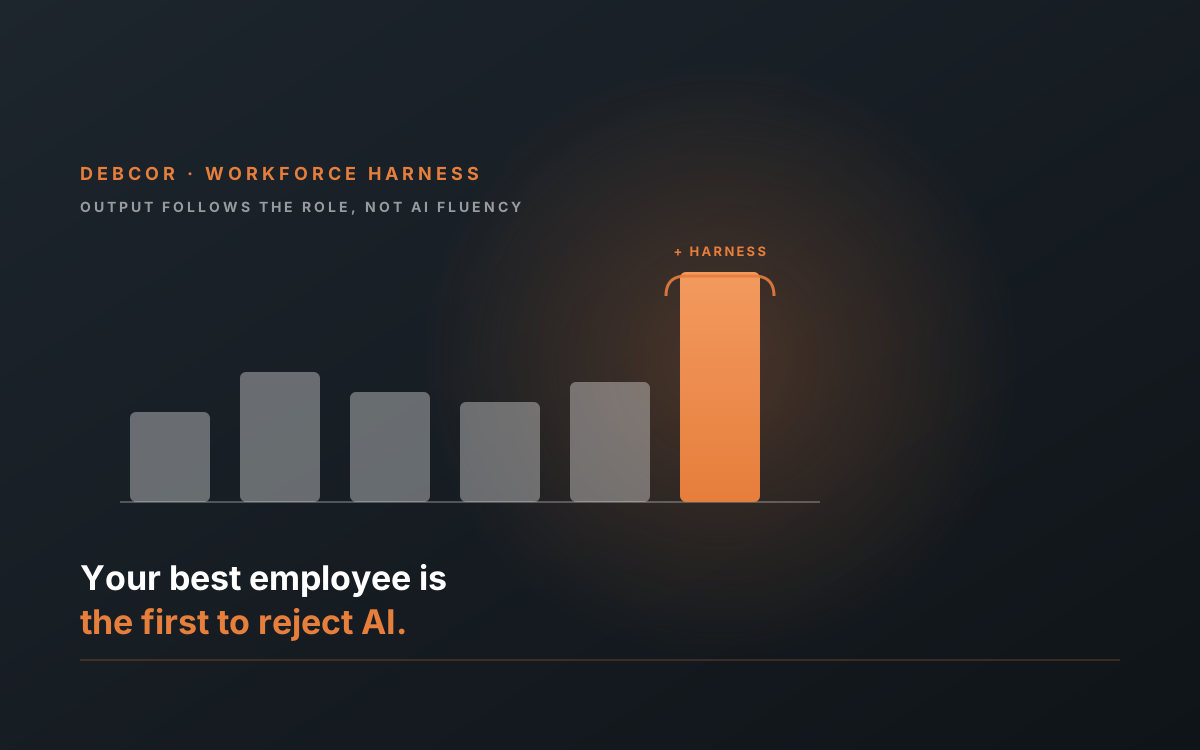
Say you have a team of six. Everyone gets the same AI tools and the same access. Six months later, two people are running with it — producing constantly, trying ideas, pushing boundaries. Three use it when they need to, mostly as a smarter search bar. The sixth, your longest-tenured, highest-context person, has given up on it. She tried a handful of things, found one use she liked, and there was nothing guiding her toward the rest.
Now leadership looks at the usage dashboard. Two heavy users, three moderate, and the most expensive person on the team barely touching it. Who would you cut?
Most leaders would answer the way the dashboard tells them to. But the two heavy users are producing volume because trial-and-error prompting is fun for them, not because it is the best way to get value from the tool. And the person who needs AI the most is the lowest-volume user — because she has so much knowledge the tool cannot replicate that she cannot hand it over one prompt at a time. She walked away because she was looking for something contextual and guided, and nobody had built it.
What walks out the door
Every company that has been around for a while runs on two systems. There is the documented one — the process maps, the manuals, the configuration. And there is the real one: the override here, the exception there, the workaround that has been in place so long it might as well be policy. The real system is never written down. It lives in the heads of the people who have been there longest.
Those are the people you absolutely do not want to lose to “AI efficiency.” They hold the context that lets AI be applied well and the judgment to catch it when it is wrong. Without them, AI takes its thin understanding of your organization and turns it into a beautifully formatted error — one that takes far longer to find, because nobody wants to believe such a capable tool is making mistakes.
You cannot run AI on knowledge you just laid off.
An engine is not a car
AI is exciting because it is powerful. But power on its own is useless and a little dangerous. A large AI model is an engine — impressive, heavy, and good for nothing until you build a car around it. The steering, the brakes, the seatbelts, the dashboard, the rules of the road. Nobody drives an engine.
The people who build AI agents learned this early. The model turned out to matter less than they expected, and the wrapper around it mattered far more: the instructions, the tools it can reach, the lines it cannot cross, the check on its output before anything leaves. They call that wrapper a harness. Same engine, different harness, completely different results.
Apply that to people and you get what we call a workforce harness. A workforce harness is a role-based operating layer that gives every role on a team the standards, tools, guardrails, and AI capability its work needs — so output depends on the role, not on how AI-fluent any one person happens to be.
The sixth person, with a harness
It was never about her. It was about the role — and nobody had designed one.
With a harness, she does not have to become a prompt engineer. The harness carries the AI; she carries the judgment. The tools she needs are already fitted to her work. The standards her output has to meet are enforced while she produces it, not caught in review three days later. What she can release on her own is clear, and so is what gets a second look. And the exceptions she has carried in her head for twenty years finally have somewhere to go.
She is no longer the lowest line on the dashboard. She is the highest-value producer on the team, because the harness turned her context into output without asking her to change who she is.
Roles, not people
A harness is built around a role, not an individual. Broader than a task, narrower than a department — the right size to be specific and still last. A project manager, a functional consultant, and an integration engineer need three different harnesses, drawn from one shared foundation.
That is also why it holds up. If a project manager moves into integration engineering, she picks up a different harness. If a project manager leaves, the next one steps into the same harness and is productive quickly. The knowledge stays with the role. That is business continuity, not just AI adoption.
What to do this quarter
Three things, none of which require a new tool.
Go talk to your veteran. Not to sell her another seat of an AI tool — to learn everything she knows that is not written down, and where AI could lift her role.
Frame AI adoption as a question of roles instead of people. Your enthusiasts will stay enthusiasts. The question is how every role in the organization gets the lift.
Measure output, not usage. If what each role produces goes up and what needs a senior rewrite goes down, the headcount conversation changes on its own.
Where we stand
We built a workforce harness for our own roles at deBCor Engineering before offering it to anyone, because we had the same problem in miniature: a small core team of deep SAP experts, finite hours, and a market moving faster than any hiring plan. We know what a project manager’s or a functional consultant’s harness needs to contain because we have done every one of those jobs. We are measuring the results on our own team now, and I will publish the numbers when they are in.
Building a harness is hard. It will not come from the next training class or the next tool. But it is the difference between a couple of AI-enabled employees and an AI-enabled team — and it is the only version of “AI efficiency” that gets more valuable every year instead of less.
The math is simpler than the slide makes it look. Tokens are cheap and getting cheaper. Your people are not. Spend money on tokens. Invest in your workers.
Common Questions
What leaders ask about workforce harnesses.
What is a workforce harness?
A workforce harness is a role-based operating layer that gives every role on a team the standards, tools, guardrails, and AI capability its work needs — so output depends on the role, not on how AI-fluent any one person happens to be.
Does a workforce harness replace employees?
No — it is the opposite. The harness exists so a company gets more output from the people it already has, instead of cutting them and losing the institutional knowledge that made the business work.
Why is our most experienced person often the lowest AI user?
Because deep knowledge cannot be handed to a tool one prompt at a time. The highest-context people are frequently the least inclined to experiment, so without something contextual and guided built for their role, they try a few things and walk away. That is a design gap, not a people problem.
Do we need to buy new AI tools to build a harness?
Usually not. Most organizations already have the AI tools. What they lack is the harness — the role-specific fit, standards, and guardrails that turn tools into reliable output.
How is this different from AI training?
Training bets on individual enthusiasm: teach people to prompt and hope they adopt. A harness makes output follow the role instead of the person — the AI capability, standards, and guardrails are fitted to the work, so results do not depend on how AI-fluent any one person happens to be.
Topics
See how a workforce harness gets installed.
deBCor installs workforce harnesses through a management-level engagement — assess the roles, design a harness per role, install it into real work, and coach the team through the first ninety days. Priced against the cost of the headcount you would otherwise cut.
Gareth de Bruyn is the Founder and Chief Architect of deBCor Engineering, an SAP Gold Partner and AI enablement firm, and an SAP veteran of thirty years.