
Optimize · Custom Code Remediation
Your custom code is the obstacle — to migration, to AI, to everything next.
A clean SAP core is not a compliance exercise. It is the prerequisite for S/4HANA migration, for AI deployment, and for a system that can be maintained and upgraded without a program-level effort every time. DEBCOR drives you there — with AI-powered assessment and senior ABAP engineers who have seen the inside of the most complex landscapes in the world.
SAP Partner Ranking
#5 in the USA
Founded
1997 · 29 Years
Partner Tier
Gold · Expert BTP, BDC & Business Transformation
Delivery Model
Senior-Led, Global Delivery
Pedigree
Max Attention · SAP Labs Veterans
The Problem
Decades of custom code. Half of it unused. The rest blocking everything you want to do next.
A typical SAP landscape running for ten or more years has accumulated thousands of custom ABAP objects. Industry data is consistent: roughly 50–60% of that code is never executed in production. It exists because processes changed, integrations were replaced, or requirements evolved — and nobody cleaned up behind them.
The remaining custom code ranges from clean, well-designed extensions to direct modifications of SAP standard programs that block every upgrade, every cloud migration, and every AI integration you want to build.
SAP's clean core classification framework provides the map. Getting there requires the right combination of tooling to assess at scale and senior ABAP expertise to remediate with precision. Both are required. Neither is sufficient alone.
50–60%
of custom code in a mature SAP landscape is never executed in production
Level D
custom code blocks S/4HANA upgrades, AI deployments, and every modernisation path
Hours
not weeks — for a full assessment with AI-powered agents across your entire codebase
The Framework
SAP Clean Core: four levels, one destination.
SAP's maturity framework classifies every custom development object across four levels. Level A is the cloud and AI-ready standard. Level D is the priority for immediate remediation — it blocks upgrades and AI deployments until it is gone.
Released APIs & Extension Points
Extensions using only released APIs and extension points — ABAP Cloud, key-user extensibility, and side-by-side on BTP. Upgrade-stable; SAP guarantees the contract. The cloud and AI-ready standard.
SAP-Classified Classic APIs
Extensions using classic objects SAP has reviewed and classified for continued use. Conditionally stable — supported, but not contract-guaranteed the way Level A is. Not upgrade-blocking.
Unreleased SAP-Internal Objects
Extensions using SAP-internal objects that were never released as APIs. Conditionally upgrade-stable — works today, but needs review at every upgrade and can break without notice. Technical debt with a review burden.
Modifications & noAPI Objects
Modifications, direct writes to SAP tables, and objects SAP flags as noAPI. Not recommended — this is what blocks clean-core progress and inflates upgrade cost. The category a remediation engagement removes.
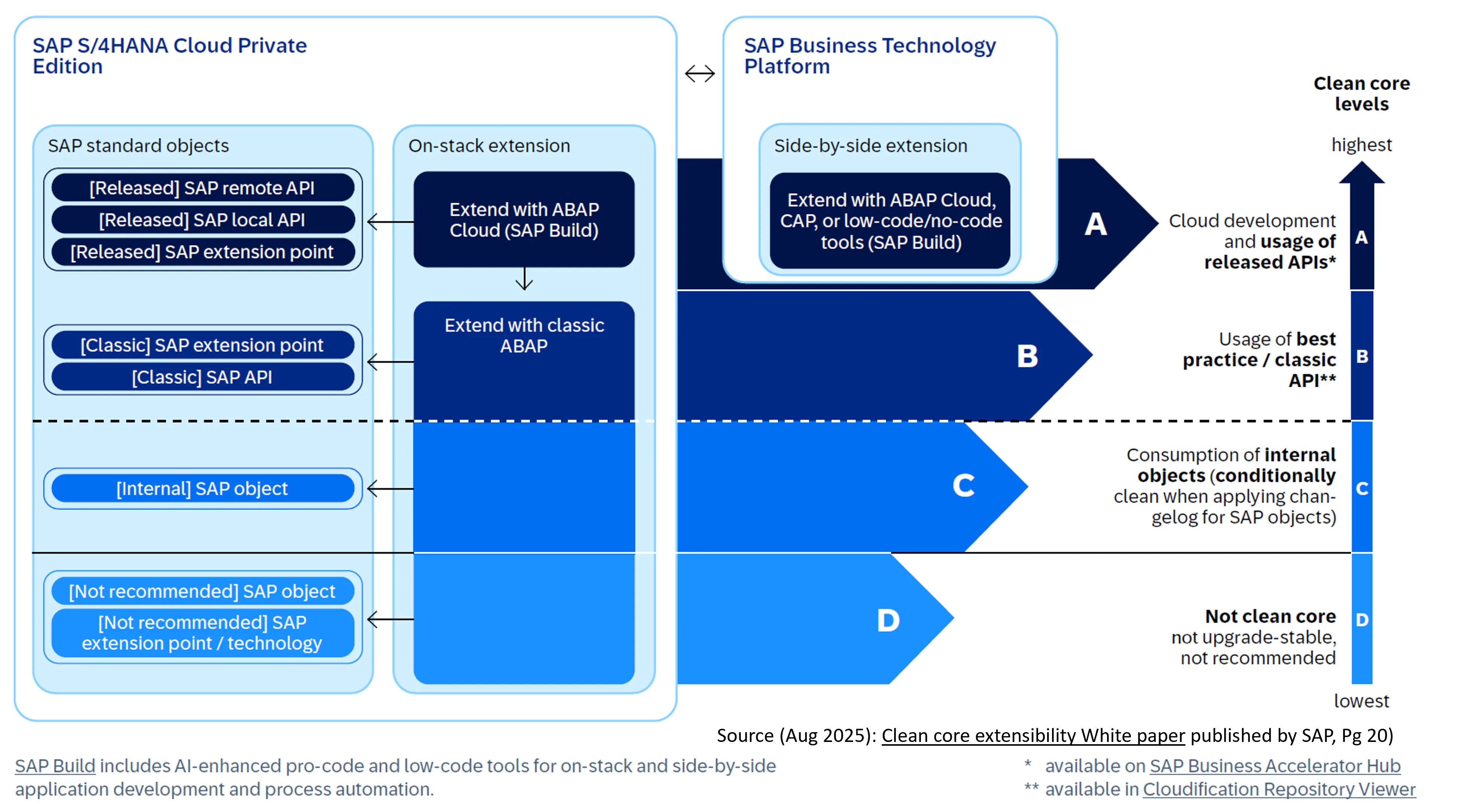
Source: SAP Clean Core Extensibility White Paper (Aug 2025), Pg 20
Moving Level D to Level C or B immediately removes every upgrade blocker — without requiring full ABAP code refactoring. That single transition unblocks your S/4HANA migration timeline and removes the largest category of AI deployment risk.
How We Deliver
Assess. Remediate. Extend via BTP.
Three phases, one outcome: a clean core with every required custom capability preserved — moved off the core and onto BTP where it belongs.
Assess
Remediate
Extend via BTP
Phase 01 — Assess
Know what you have — completely
Our AI-powered agents analyze your entire ABAP codebase in hours. Every custom object is classified against the SAP clean core framework: used vs. unused, Level A through D, upgrade impact, and AI-readiness risk. What once took weeks of manual ATC review now surfaces in a single sprint — with higher coverage and no analyst fatigue.
Phase 02 — Remediate
Drive Level D to zero
Our senior ABAP developers — veterans of SAP Max Attention engagements and SAP Labs — work through the remediation backlog with precision and speed that only comes from decades at the sharp end of the most complex SAP landscapes in the world. Agent-assisted remediation handles the repeatable patterns. Senior judgment handles the architectural decisions. Nothing gets moved without a human expert signing off.
Phase 03 — Extend via BTP
Required custom code belongs on BTP
Not all custom code can be eliminated — some represents genuine business logic that doesn't exist in standard SAP. That code doesn't stay in the core. We design and build it as side-by-side extensions on SAP BTP: clean, upgrade-safe, AI-accessible, and decoupled from the core's upgrade cycle. The core stays clean. The business capability stays intact.
Why This Matters
Clean core is the foundation. For everything.
Every board conversation about AI and every CFO conversation about S/4HANA migration converges on the same prerequisite: a codebase that is understood, trusted, and clean. Custom code remediation is not a project that precedes the real work. It is the real work.
Unknown code is the highest AI risk
AI agents and automation layers act on system outputs. If those outputs are generated by custom code containing unreleased API calls, direct table modifications, or undocumented logic, you are automating on top of a system you don't fully understand. The AI will confidently do the wrong thing — and nobody will know why until something breaks badly.
Level D code blocks AI extensibility
Modern SAP AI capabilities — Joule, AI Foundation on BTP, predictive analytics — are designed to integrate via clean extension points and released APIs. Level D code either blocks those integrations or creates dependency chains that make them fragile. Clean core is not a prerequisite for AI someday. It is the prerequisite for AI now.
Data you can trust requires code you can trust
AI requires clean, consistent data. Direct writes to SAP tables — a defining characteristic of Level D code — undermine data integrity at the source. Before a model can learn from your operational data, you need to know that your operational data reflects reality. That requires understanding every code path that touches it.
Clean core and S/4 migration are the same program
Every dollar invested in custom code remediation during a migration is a dollar that doesn't need to be spent later preparing AI training data or rebuilding integration points. The remediation work enables both simultaneously. This is not two investments — it is one.
The S/4HANA migration forces the master data cleansing, the process integration, and the system understanding that AI requires. Remediate the custom code as part of that program and you are not paying twice. You are doing both at once.
Read our executive brief on AI and S/4 ROI →Why DEBCOR
The right combination of tooling and people.
Custom code remediation at scale requires two things that are genuinely hard to find together: AI-powered agents that can assess thousands of objects without fatigue or sampling bias, and senior ABAP engineers with the depth to make the architectural decisions that determine whether the remediation actually sticks. DEBCOR brings both.
Max Attention Veterans
Our senior ABAP developers have worked at the highest level of SAP support — Max Attention engagements for the world's most complex SAP landscapes. They have seen every custom code pattern, including the ones that only appear under genuine production pressure.
SAP Labs Pedigree
Engineers with direct SAP Labs experience bring an inside understanding of how SAP standard code is designed, which API boundaries are stable, and where extensibility was intentionally built. That knowledge makes remediation decisions faster and more reliable.
AI-Powered Code Assessment
DEBCOR's proprietary agents scan entire custom code landscapes — classifying objects, identifying violation patterns, and prioritizing remediation by upgrade risk and AI-readiness impact. Comprehensive assessment in hours, not weeks.
29-Year ABAP Pedigree
Founded by one of the first SAP-certified ABAP engineers in the world and the author of the first ABAP book ever published. The depth of ABAP knowledge at DEBCOR is not a credential — it's the foundation everything else is built on.
BTP Expert Competency
SAP-certified Expert in BTP. When custom code has to move off the core, we design and build it correctly — as clean, upgrade-safe BTP extensions that integrate with the standard via released APIs and remain accessible to AI tooling.
Three Patents Pending
Proprietary IP in AI-accelerated code analysis and remediation tooling. You benefit from technology built specifically for this problem — not generic code analysis tools repurposed for SAP.
“DEBCOR's white-glove approach to consulting isn't just a tagline — it's the reality of their service. They've been our trusted partner for many years. At our request, they cleaned up our technical debt and prepared us for S/4HANA. The migration only took four months — we were down for maybe a weekend, then back to business with no loss in revenue.”
FAQ
Common questions.
What does 'clean core' actually mean in practice?
SAP defines a clean core as a system where custom development is minimised, and where any necessary extensions are built using released APIs and standard extensibility frameworks — not direct modifications to SAP standard objects. In practice, it means your system can be upgraded without custom code rework, your integrations are stable across upgrades, and AI tools can safely operate on reliable, well-understood data and process outputs.
What is Level D code and why does it matter so much?
Level D is SAP's classification for the least clean-core-compliant custom code: modifications to SAP standard objects, direct writes to SAP-owned tables, and objects SAP flags as noAPI. It is not upgrade-stable — it blocks S/4HANA upgrades, creates integration fragility, and is the single biggest technical obstacle to AI deployment. (Extensions that merely use unreleased SAP-internal objects fall into Level C — conditionally upgrade-stable, but still carrying a review burden at every upgrade.) Eliminating or converting Level D code is the highest-priority remediation task in every clean core program.
How much custom code do most organizations have that isn't being used?
Industry analysis consistently shows that 50–60% of custom code in a mature SAP landscape is never executed in production. It exists because it was built for a process that changed, a report that no one runs, or an integration that was replaced years ago. That code still carries maintenance overhead, still gets included in upgrade impact analyses, and still poses a security and compliance surface. Removing it is the highest-leverage first step in any clean core program.
Can we do clean core remediation separately from our S/4 migration?
Yes — but structuring it as part of the migration is almost always the better investment. When remediation runs as a pre-migration workstream, every object you clean reduces migration complexity, shortens the upgrade timeline, and eliminates post-migration rework. Done independently of migration, you pay for the work twice: once to clean the code and once to validate it again during migration. We recommend treating them as a single program wherever the timeline allows.
What happens to custom code that genuinely can't be eliminated?
Some custom code represents real business logic that has no standard SAP equivalent and can't be removed without losing business capability. That code moves to SAP BTP as a side-by-side extension — cleanly decoupled from the core, built using released APIs, and accessible to AI tooling. The core stays clean. The business capability stays intact. The extension can evolve independently without touching upgrade-sensitive objects.
How long does a remediation program typically take?
Assessment — understanding the full scope of what you have — typically takes days to a couple of weeks depending on codebase size, thanks to our AI-powered tooling. Remediation scope varies significantly: a program focused on Level D removal and unused code elimination can move fast; a full Level A target across a large landscape is a multi-quarter effort. We provide a prioritized remediation backlog at the end of assessment so you can make an informed scope decision before committing to the full program.
Remediating code ahead of a migration?
See RISE with SAP →Custom code moved to BTP — now what?
See SAP BTP Services →Want ongoing stewardship post-remediation?
See AMS / Managed Services →Start with the assessment.
We'll give you a complete picture of your custom code landscape — classified, prioritized, and costed — before you commit to a remediation program.