
ECC End-of-Support · Decision Framework · 10 min read
ECC Extended Maintenance to 2030 — what it actually buys you.
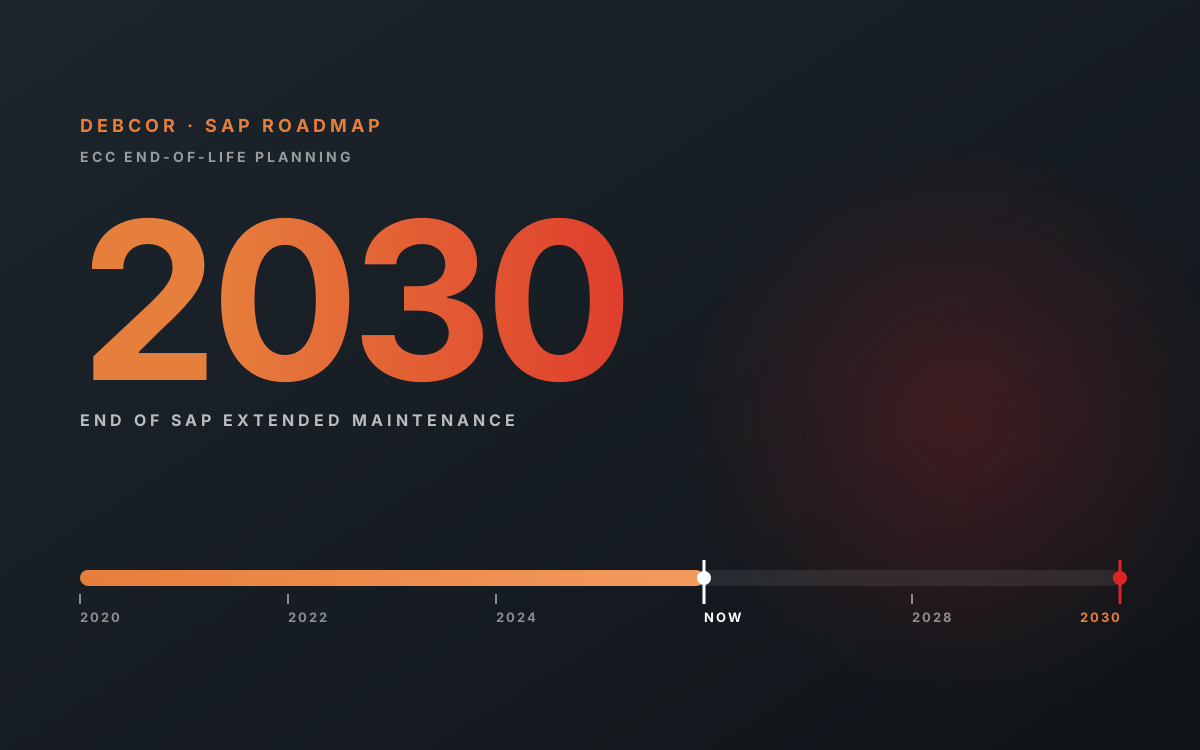
SAP ECC mainstream maintenance ends December 31, 2027. Optional Extended Maintenance runs to December 31, 2030 at a surcharge. SAP's CEO has publicly confirmed there will be no further extensions. The decision every ECC customer needs to make between now and 2027 is not “ECC or S/4HANA” — it is which of four realistic paths fits the business's actual constraints.
This is what Extended Maintenance covers, what it doesn't, and how to think about the four paths — including one (ECC on RISE) that most ECC marketing skips entirely.
By Gareth de Bruyn, Founder & Chief Architect, DEBCOR Engineering.
Extended Maintenance — covered vs. not covered.
✓ Covered through Dec 31, 2030
- Standard SAP-issued bug fixes and patches
- Regulatory and legal updates SAP routinely ships (tax tables, e-invoicing, country-specific compliance)
- Security patches on the SAP-supported track
- Continued access to SAP support channels for break-fix tickets
- Compatibility with the in-scope SAP NetWeaver/HANA versions running ECC at extension start
✗ Not covered (planning matters)
- Net-new features. SAP is not adding capabilities to ECC. The product is frozen.
- New regulatory regimes ECC's architecture cannot accommodate (e.g. new e-invoicing standards that require schema changes beyond what ECC supports).
- Third-party integration partners who drop ECC support before 2030 (Salesforce, banking gateways, EDI partners — each makes its own call).
- Hyperscaler infrastructure for self-hosted ECC. If your ECC is on a cloud provider that EOLs its ECC-compatible instance types, that's a separate problem.
- Industry-specific extensions that depend on the broader SAP product portfolio's evolution (S/4HANA-only features cannot retrofit to ECC).
- Customer-specific maintenance after December 31, 2030. ECC enters CSM, where you keep ECC running but SAP no longer ships patches.
The Decision
Four realistic paths. Pick one with eyes open.
These are not equal options. Each fits a specific kind of ECC customer with specific constraints. The wrong choice locks an organisation into a more expensive future.
Path 1
Path 1 — Stay on ECC + buy Extended Maintenance
- Cost:
- ≈2% surcharge on annual maintenance fees, plus your existing self-hosted infrastructure cost
- Horizon:
- Through December 31, 2030
- When this is right:
- When migration genuinely cannot complete in the remaining window. Buys 3 more years of standard patching. The cheapest insurance — but you still need a plan for 2030.
- Risk:
- You will need to migrate by 2030 regardless. Extended Maintenance defers, it does not solve. The 2030 deadline arrives with no further extensions; planning runway then is zero.
Path 2
Path 2 — Move ECC to RISE private cloud (no S/4HANA conversion yet)
- Cost:
- RISE subscription replaces ECC perpetual licence + maintenance; infrastructure shifts to SAP-managed
- Horizon:
- Operationally stable through the RISE contract; S/4HANA conversion staged when ready
- When this is right:
- When you want off self-hosted ECC operations now but cannot complete the S/4HANA conversion before 2027. Most underused option in the ECC playbook.
- Risk:
- You still owe yourself the S/4HANA migration eventually. Path is sound but it's a step, not a destination.
Path 3
Path 3 — Migrate to S/4HANA Cloud, Private Edition via RISE (brownfield/bluefield)
- Cost:
- Typical USD $1M–$5M for partner-delivered ECC-to-S/4HANA Private Cloud migration, plus RISE subscription replacing ECC licence + maintenance
- Horizon:
- Permanent. Modern platform, AI-ready, supported through SAP's roadmap
- When this is right:
- The primary path for most existing ECC customers — preserves custom code carry-forward, customisations, and history through brownfield system conversion or bluefield selective transition. iFIT public reference: ECC to S/4HANA in 4 months, zero revenue loss.
- Risk:
- Requires committed timeline. Skip the landscape clean-up phase and 12-month migrations become 24-month migrations.
Path 4
Path 4 — Re-implement on S/4HANA Cloud Public Edition via GROW
- Cost:
- Greenfield programme cost (typically lower on partner delivery, higher on change-management scope) + GROW subscription
- Horizon:
- Permanent. Clean core, quarterly innovation, AI-from-day-one
- When this is right:
- Only when the business is genuinely willing to adopt SAP best practices and let go of legacy customisation. Greenfield re-implementation — your custom code does not come with you.
- Risk:
- Underestimating the change-management lift. Forcing standard onto a non-standard business model produces workarounds that erase the cost advantage.
The 2030 Reckoning
Extended Maintenance defers. It does not solve.
Buying Extended Maintenance through 2030 is the right call when migration genuinely cannot complete in the remaining window. It is not a strategy. By January 1, 2031, ECC enters Customer-Specific Maintenance — you keep ECC running on your own infrastructure, with no SAP-supplied patches, no SAP-issued regulatory updates, and increasingly limited third-party support. The organisations that buy Extended Maintenance and then do nothing reach 2030 with the same migration to do, less runway than today, and a partner ecosystem that has been quietly EOL'ing ECC support all along.
The honest framing: Extended Maintenance buys three years of stability while you execute the migration. Treat it that way and it's a tactical win. Treat it as a permanent shelter and it's the most expensive form of denial in the SAP ecosystem.
Common Questions
What ECC customers ask before picking a path.
What is the exact SAP ECC end-of-support date?
SAP Business Suite 7 (which includes SAP ECC 6.0) reaches end of mainstream maintenance on December 31, 2027. Optional Extended Maintenance runs through December 31, 2030 at a surcharge. SAP's CEO has publicly confirmed no further extensions beyond 2030. After 2030, ECC enters Customer-Specific Maintenance — you keep ECC running on your own with no SAP-supplied patches available.
Does Extended Maintenance to 2030 cover security patches?
Yes — on the standard SAP-supported security track. SAP continues to ship security patches for ECC during Extended Maintenance. What it does not cover: new architectural security models that ECC cannot accommodate (e.g. modern identity protocols requiring infrastructure changes ECC's core was not built for), and third-party integration partners who drop ECC support before 2030.
Can RISE actually host ECC, or only S/4HANA?
Both. RISE with SAP private cloud infrastructure can host either your existing SAP ECC system or SAP S/4HANA Cloud, Private Edition. ECC on RISE is the underused interim path for customers who need to exit self-hosted ECC operations now but defer the S/4HANA conversion — same commercial relationship, SAP-managed infrastructure, while you stage the S/4 migration on a longer horizon.
What if we already started a failed S/4HANA migration and now the deadline is closer?
The Rescue Squad pattern. DEBCOR has one of the most documented SAP rescue practices in the United States — the signature reference is McLarens Insurance, a Fortune 500 insurer where DEBCOR delivered the global SAP Public Cloud transformation in five months across 54 countries after a major SI had spent three years without reaching go-live. Step one is a Project Health Check (2–3 weeks) producing an honest recovery plan; step two is decisive recovery execution. ECC customers who started a failed conversion now have less runway than the original timeline — moving fast matters.
Topics
Want an honest path recommendation for your landscape?
DEBCOR's ECC readiness assessment audits your landscape across five dimensions — custom code volume, data quality, integration map, business-process maturity, and timeline reality — then produces a written recommendation across all four paths. Two to three weeks, fixed-bid, USD $25k–$75k. No sales pitch baked in.