
S/4HANA Migration · Comparison · 14 min read
RISE vs GROW with SAP — the value-driven decision for your business.
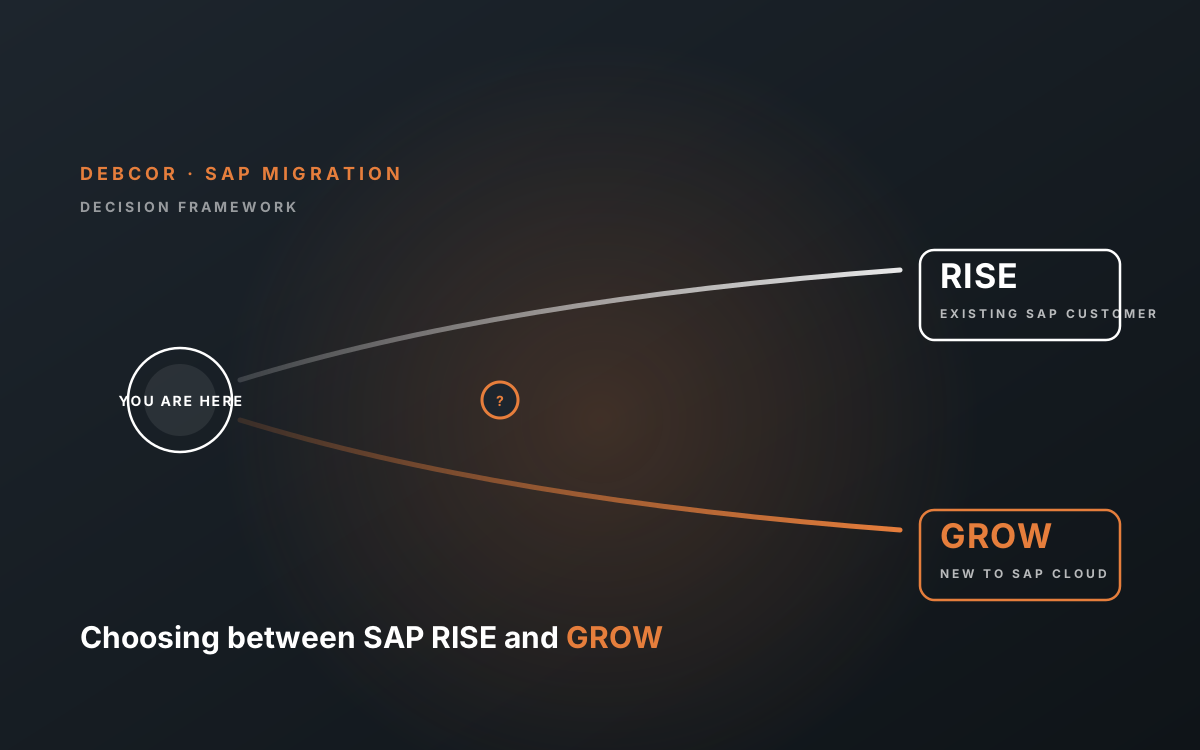
There is real confusion in the SAP market about RISE with SAP and GROW with SAP — what each product is, what each delivers, and which fits a given business. This article decouples the two. RISE delivers SAP S/4HANA Cloud, Private Edition — and, as most buyers don't realise, can also host your existing ECC system on the same RISE private cloud infrastructure. GROW delivers SAP S/4HANA Cloud, Public Edition. They are different products designed for different buyers, with different value structures. The objective is not to pick a winner; it is to match the right product to the right business model.
This decision framework comes from a team that has delivered both at public-reference scale — a global insurance leader on GROW (S/4HANA Public Cloud, 54 countries, delivered in five months) and iFIT on RISE (ECC to S/4HANA, four months, zero revenue loss).
By Gareth de Bruyn, Founder & Chief Architect, DEBCOR Engineering. 30+ years of SAP delivery. 13 published SAP books, including the first ABAP textbook ever published.
TL;DR
Both RISE and GROW are excellent products. The right choice is the one that fits your business model — and the decision is more about business value than technology.
RISE is the natural fit for existing ECC customers with deep customisation that delivers genuine business value, and for complex regulated enterprises that need timing and tenancy control. GROW is the natural fit for net-new SAP buyers and organisations replacing NetSuite, Dynamics, Sage, or Oracle who want SAP's most AI-forward deployment with a clean-core foundation. The ECC-on-RISE option also gives existing ECC customers a real third path that most buyers miss. The detailed value-fit analysis follows.
RISE vs GROW — side by side
| Dimension | RISE with SAP | GROW with SAP |
|---|---|---|
| S/4HANA edition | Cloud, Private Edition (single-tenant) | Cloud, Public Edition (multi-tenant SaaS) |
| Customisation | Full — ABAP, custom Z-code, modifications, RAP, BTP extensibility | Configuration + BTP-side extensibility only (no in-line ABAP modifications of standard) |
| Innovation cycle | Customer-controlled upgrade timing | SAP-controlled, quarterly |
| Carry-forward of ECC custom code | Yes (brownfield/bluefield) | No (greenfield re-implementation) |
| Hyperscaler choice | Azure, AWS, GCP, or SAP DC | SAP-managed; hyperscaler not the customer's choice |
| ECC hosting option | Yes — ECC on RISE private cloud as an interim path | No — net-new system |
| Time-to-value | 9–18 months typical for ECC-to-S/4 conversion | 12–20 weeks for GROW Fast Minimum Viable Scope |
| Best-fit buyer | Existing ECC customer; complex enterprise; regulated; deep customisation value | Net-new SAP; mid-market; replacing NetSuite/Dynamics/Sage/Oracle |
| Worst-fit buyer | Standardised business model with no real customisation value | Heavy ECC customisation with genuine business value |
| Joule entitlements | Included | Included |
| BTP credits included | Yes | Yes |
Where RISE delivers more value
Four business shapes where RISE wins on value.
GROW is excellent for the right buyer — structurally cheaper at scale, fastest time-to-value, SAP's most AI-forward deployment from day one. These are not anti-GROW takes. They are four specific business shapes where the RISE value model produces a better outcome for that buyer:
- 1
You have heavy ECC customisation that delivers genuine business value (not technical debt). GROW is greenfield by design; your custom code does not come with you. The transformation cost of re-implementing those processes on SAP standard often exceeds the lifetime TCO advantage of public cloud — making RISE the more economical path when the customisations carry real P&L weight.
- 2
You operate in a regulated industry with industry-specific extensibility requirements that don't fit a public-cloud standard package. Pharma, life sciences, defense, financial services — RISE preserves the ability to keep the extensions that compliance requires.
- 3
You need quarterly innovation control. SAP controls GROW's release calendar; if a major release lands during your year-end close, your finance team handles it. RISE gives you the timing flexibility regulated and high-availability customers often need.
- 4
Your custom integrations rely on architectural patterns that don't map to BTP-side extensibility. Some legacy integration patterns (in-line modifications of standard programmes, direct DDIC manipulation, custom function modules called from external systems via classical RFC) work in RISE and not in GROW — so RISE preserves more of the existing investment.
Where GROW delivers more value
Four business shapes where GROW wins on value.
RISE is the right answer for most existing ECC customers and complex enterprises. These are not anti-RISE takes. They are four specific business shapes where the GROW value model produces a better outcome for that buyer:
- 1
You're a net-new SAP customer with no legacy customisation to carry forward. GROW's clean-core foundation, quarterly innovation, and SAP-most-AI-forward deployment model from day one is the better economic match — you get more value per dollar without paying for RISE's customisability options you'd never exercise.
- 2
Your business processes are genuinely standard and align well to SAP best practices. GROW's licence and partner-delivery cost are structurally lower at scale; if you don't need RISE-level customisation flexibility, GROW is real savings, not a compromise.
- 3
Your buying organisation is mid-market and time-to-value matters more than architectural depth. GROW Fast was designed for exactly this scenario — 12–20 weeks to Minimum Viable Scope production on Finance Base and Supply Chain Base, AI-ready from day one. The DEBCOR public reference is a global insurance leader who went live on GROW across 54 countries in five months.
- 4
You want SAP to manage everything including the hyperscaler relationship. GROW's all-SAP-managed model is simpler operationally — fewer commercial relationships, fewer infrastructure decisions, fewer moving parts to coordinate. For organisations that value operational simplicity, that's a clear win.
The Nuance Most Buyers Miss
RISE can host your existing ECC system — not just S/4HANA.
Most RISE marketing equates RISE with S/4HANA Cloud, Private Edition. The reality is broader: RISE's private cloud infrastructure can host either S/4HANA Private Edition or your existing SAP ECC system on the same RISE commercial envelope. That gives ECC customers a real third option besides “buy extended maintenance and stay self-hosted” or “rush the S/4 conversion before December 2027.”
ECC on RISE: get off self-hosted ECC operations now, onto SAP-managed cloud, under a unified SAP commercial relationship — then stage the S/4HANA conversion within the same RISE contract whenever the business is ready. The transition is smoother, the operational risk is lower, and you stop maintaining ECC infrastructure that's heading toward end-of-support regardless.
See the full ECC End-of-Support decision tree →Common Questions
What buyers ask before they commit to RISE or GROW.
Can RISE host ECC, or only S/4HANA?
Both. RISE with SAP private cloud infrastructure can host either your existing SAP ECC system or SAP S/4HANA Cloud, Private Edition. ECC on RISE is the underused path for customers who need to exit self-hosted ECC operations now but can't complete the S/4HANA conversion before the 2027 deadline — you stabilise on SAP-managed cloud, defer the conversion, and stage the S/4HANA migration within the same RISE commercial envelope when the business is ready.
What if we go GROW now and need to customise later?
You build extensions on SAP BTP — side-by-side apps using Cloud Application Programming Model (CAP), Build, Build Code, or Build Apps — never in-line modifications of S/4HANA standard. This is the clean-core principle, and for most net-new customers it covers what they actually need. For organisations whose business model genuinely requires deep in-line modifications of SAP standard, RISE is the better value fit from the start; switching to RISE after going live on GROW is more expensive and disruptive than committing up-front. The decision is best made before go-live, not discovered after — which is why DEBCOR's standard pattern is landscape and process analysis before recommending either product.
Is RISE always the right answer for existing ECC customers?
Usually yes, but not always. RISE is the natural ECC successor because of customisation carry-forward and the ECC-on-RISE interim option. GROW from ECC is viable only when the business is genuinely willing to adopt SAP best practices and let go of legacy customisation — a structural change-management decision, not a technical one. DEBCOR's standard pattern is landscape analysis first, then honest path recommendation based on what is actually worth carrying forward.
What about the long-term cost?
GROW is structurally cheaper at scale because it's multi-tenant SaaS with SAP-controlled upgrades. RISE has higher per-customer infrastructure and operations cost because it's single-tenant. But the cost comparison depends on what you actually need: if your business model genuinely fits SAP standard, GROW's lower cost is real value. If you need RISE-level customisation and try to use GROW, the cost of forcing standard onto a non-standard business — workarounds, manual processes, lost productivity — usually exceeds RISE's premium.
Topics
Need an honest read on your specific landscape?
DEBCOR's standard pattern: landscape analysis first, then a written recommendation across all three options (ECC on RISE, RISE S/4HANA, GROW) with the specific trade-offs that apply to your business. Two to three weeks, fixed-bid. No sales pitch baked in.