
SAP AI · Build Decision · 12 min read
Joule Studio vs custom A2A agents on BTP — the build-track decision.
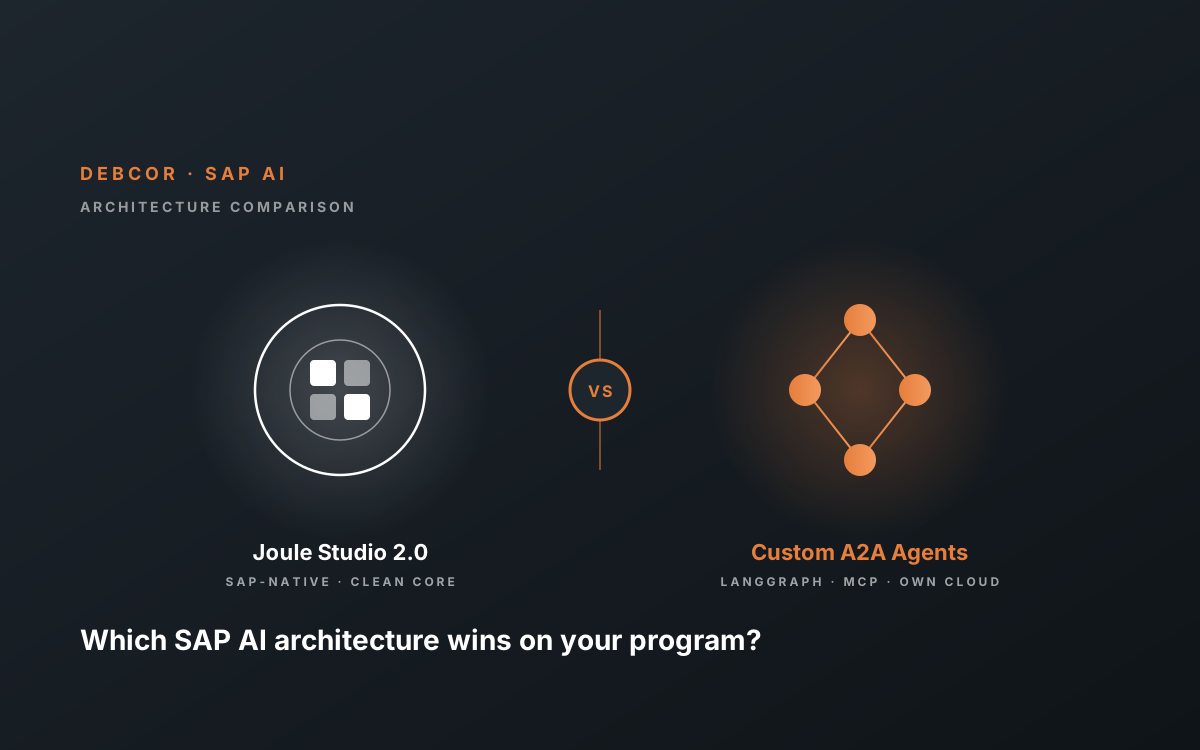
The most common misconception in the SAP AI market right now is that A2A (Agent-to-Agent) interoperability requires Joule Studio 2.0. It does not. A2A on BTP works today via SAP's open-source joule-a2a-agent-toolkit. Most organisations need both tracks — Joule Studio for the use cases SAP has paved, custom A2A agents for everything else. The question is which goes where, and in what order.
By Gareth de Bruyn, Founder & Chief Architect, DEBCOR Engineering. Anthropic Claude Preferred Services Partner. Three patents pending in enterprise AI integration.
TL;DR
Use Joule Studio for SAP-paved scenarios where time-to-first-agent matters and the customisation surface fits. Use custom A2A agents on BTP for everything Joule doesn't cover natively yet — including most production scenarios in regulated industries.
A2A interoperability is available today on the current platform via the joule-a2a-agent-toolkit. Joule Studio 2.0 (managed runtime GA Q3 2026) adds bidirectional A2A improvements and removes the need to provision Cloud Foundry / AI Core yourself, but does not gate the core capability. The teams that build their first Joule + custom-agent integration on the current stack will be the first to ship managed-runtime production scenarios when Studio 2.0 lands.
Joule Studio vs custom A2A agents — side by side
| Dimension | Joule Studio | Custom A2A on BTP |
|---|---|---|
| Authoring model | Low-code visual builder | Pro-code (LangGraph in Python, CAP in TypeScript) |
| Runtime | SAP AI Core (managed by SAP) | BTP Cloud Foundry (operated by you or your partner) |
| GA status today | Original Joule Studio GA since May 2026 | A2A on BTP GA today via joule-a2a-agent-toolkit |
| Connectivity | SAP-curated MCP connections + Joule Knowledge Graph grounding | MCP, Integration Suite, BTP Destination Service — full flexibility |
| Customisation depth | Limited to the Studio's prompt + tool surface | Full — any reasoning chain, any tool, any data source |
| Time-to-first-agent | Days for standard scenarios | 1–3 weeks for first agent + governance baseline |
| Ownership | SAP-paved scenario | Customer owns the architecture, partner operates |
| Cost shape | Subscription via RISE/GROW Joule entitlement | BTP consumption (Cloud Foundry + AI Core/Generative AI Hub) + partner engagement |
| Audit + governance | SAP-provided baseline | Customer-defined via Governance + Auditing Agent layers |
| A2A interoperability | Bidirectional A2A improvements landing in Joule Studio 2.0 | Native A2A from day one via joule-a2a-agent-toolkit |
Decision Framework
Three questions that pick the track for you.
Does SAP already have a Joule-paved scenario for this use case?
If yes → Joule Studio is almost always the right starting point. SAP's investment in the paved-scenario library is real, the time-to-first-agent advantage is significant, and you ride SAP's roadmap as it expands. Examples: financial close acceleration, customer service tier-1 deflection, IT helpdesk automation, employee onboarding.
Does the scenario need customisation beyond what Joule Studio's prompt + tool surface allows?
If yes → custom A2A agent on BTP. Examples: industry-specific compliance workflows, complex multi-system orchestration, custom EDI/B2B flows, regulated audit evidence generation, scenarios that need explicit Governance and Auditing Agent layers, or any reasoning chain Joule Studio doesn't natively express. The custom track gives you any model, any tool, any reasoning shape.
Will the agent eventually need to coordinate with agents from other organisations (suppliers, customers, regulators) via A2A?
If yes → custom A2A is the safer bet today. Bidirectional A2A — external agents natively invoking Joule agents — improves in Joule Studio 2.0 but is more mature on the custom track. Cross-organisation agent collaboration is the longer-term horizon SAP and Google are building toward; building custom A2A now positions you to lead when the broader ecosystem matures.
Most Production Estates Use Both
One agent estate. Two build tracks. One operating model.
The mature pattern is not Joule-or-custom. It is Joule-for-paved and custom-for-everything-else, riding the same five-layer architecture — Orchestration, Intelligence, Worker, Governance, Auditing — with the Company Intelligence Layer compounding client-specific knowledge across both tracks. A behaviour learnt while operating a custom procurement agent informs how a Joule finance agent is grounded.
DEBCOR has been operating this pattern in production with SAP customers for roughly 18 months — i.e. since before SAP announced the same stack at Sapphire 2026. The DEBCOR AI Platform documents how the layers fit together; the operations discipline (token-cost monitoring, prompt versioning, model version pinning, regression testing, IAS App2App trust, audit retention) is the same regardless of which track an individual agent was built on.
See the DEBCOR AI Platform architecture →Common Questions
What CIOs ask before they pick a build track.
Do we need Joule Studio 2.0 to use A2A on BTP?
No — this is the most common misconception in the market right now. A2A on BTP works today. SAP's joule-a2a-agent-toolkit (open-sourced on GitHub under SAP-samples) scaffolds an A2A-compliant agent in LangGraph or CAP, deploys to Cloud Foundry, and registers with Joule in a single command. IAS App2App trust handles authentication. Synchronous, asynchronous, and multi-turn conversation patterns are all supported. What Joule Studio 2.0 adds is bidirectional A2A improvements (external agents more natively invoking Joule agents) and a fully managed runtime targeted Q3 2026 GA — neither is required for the core integration. Waiting is the bigger risk.
If we have RISE or GROW, do we already have Joule Studio entitlement?
Yes. Current RISE and GROW contracts include Joule entitlements (the conversational copilot across S/4HANA, SuccessFactors, Ariba) plus BTP credits and Generative AI Hub access usable for Joule grounding and custom agent development. Most organisations do not fully deploy what their contract already pays for. DEBCOR's standard pattern is to audit the entitlement up front and activate Joule against the customer's actual SAP data via the Company Intelligence Layer.
Can the same agent estate use both tracks?
Yes — and this is how most production deployments end up. Joule Studio for the use cases SAP has paved (financial close acceleration, customer service tier-1 deflection, IT helpdesk automation, employee experience). Custom A2A agents for scenarios SAP doesn't cover natively yet (industry-specific compliance, custom EDI flows, regulated audit evidence, complex multi-system orchestration). Both ride the same five-layer architecture — Orchestration, Intelligence, Worker, Governance, Auditing — and both share the Company Intelligence Layer so client-specific knowledge compounds across the estate.
Which models can the custom track use?
Any model exposed via the Generative AI Hub on BTP. Anthropic Claude (DEBCOR is an Anthropic Preferred Services Partner), Google Gemini 2.0 Flash, Gemini 1.5, Text Embedding Gecko, SAP-hosted foundation models, plus the partner library SAP keeps expanding. Selection happens per use case rather than locked at architecture time. The harmonised API on Generative AI Hub gives you a single integration point — the underlying model can change without rewriting the agent.
Topics
Funded by SAP · Through 2026
Either path may not cost what you think.
SAP has committed €100 million to partner-led Business AI adoption, funding Business AI deployments on the SAP stack through approved partners. DEBCOR Engineering is an approved partner: we architect the case with you, then navigate SAP's process end to end. The window closes at the end of 2026.
Want to map your scenarios to the right track?
DEBCOR's AI readiness assessment maps your AI use case backlog against Joule Studio vs custom A2A on the current platform, audits your existing Joule entitlement, and outputs a 90-day implementation plan for the first three agents. Two to three weeks, fixed-bid.