
Workforce Harness
Get more from the team you already have.
Most companies think AI means one of two things: fewer people, or a few power users while everyone else waits. There is a third option. A workforce harness is a role-based operating layer that gives every role on a team the standards, tools, guardrails, and AI capability its work needs — so output depends on the role, not on how AI-fluent any one person happens to be. The people who know how your business actually runs stay exactly where they are, and produce more.
Two bad options, and the one that compounds
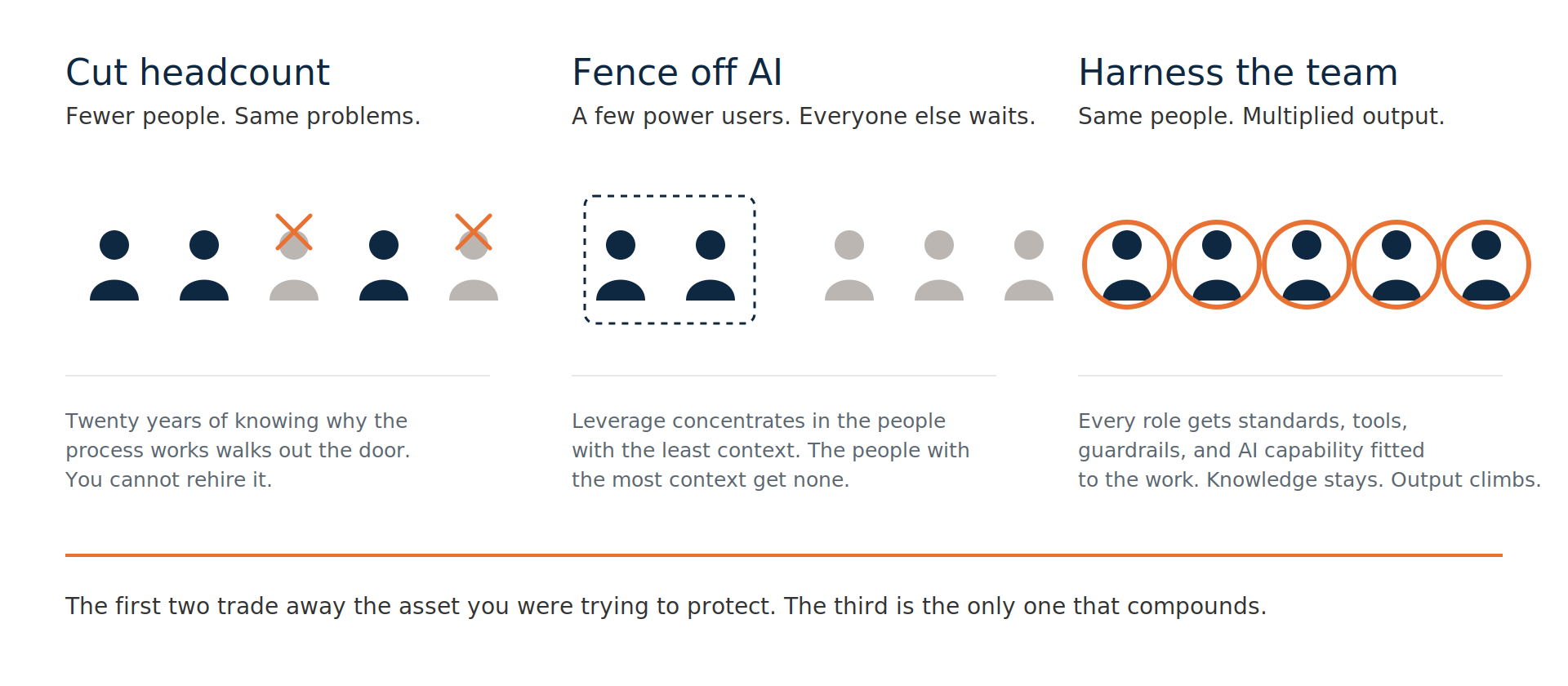
Cut headcount and you shed the people who know why the process works the way it does — and you cannot rehire that. Fence AI off for a handful of enthusiasts and you concentrate leverage in the people with the least context while the people with the most get none.
Both trade away the asset you were trying to protect. A harness keeps every person and multiplies what they produce.
A harness is fitted to the role, not the person
In the AI world, a harness is everything wrapped around a model that makes it useful for a specific job: the instructions, the tools it can reach, the rules it cannot break, the checks on its output. Same model, different harness, completely different results.
A workforce harness applies that idea to people. Every role gets four things, fitted to the work that role produces (the full argument for why is worth ten minutes):
- Standards — how a deliverable from this role must look, read, and behave before anyone sees it
- Tools and access — the systems, data, and AI capability this role can reach, and nothing it shouldn't
- Guardrails — what this role can release on its own, and what always gets a second set of eyes
- AI capability — the specific ways AI does the heavy lifting for this role's work, packaged so nobody has to become a prompt expert to use it
The components are shared. The fit is per role. A project manager, a functional consultant, and an engineer draw from the same platform and get three different harnesses — and we know what each one needs to contain because we have staffed every one of those roles on SAP programs for thirty years.
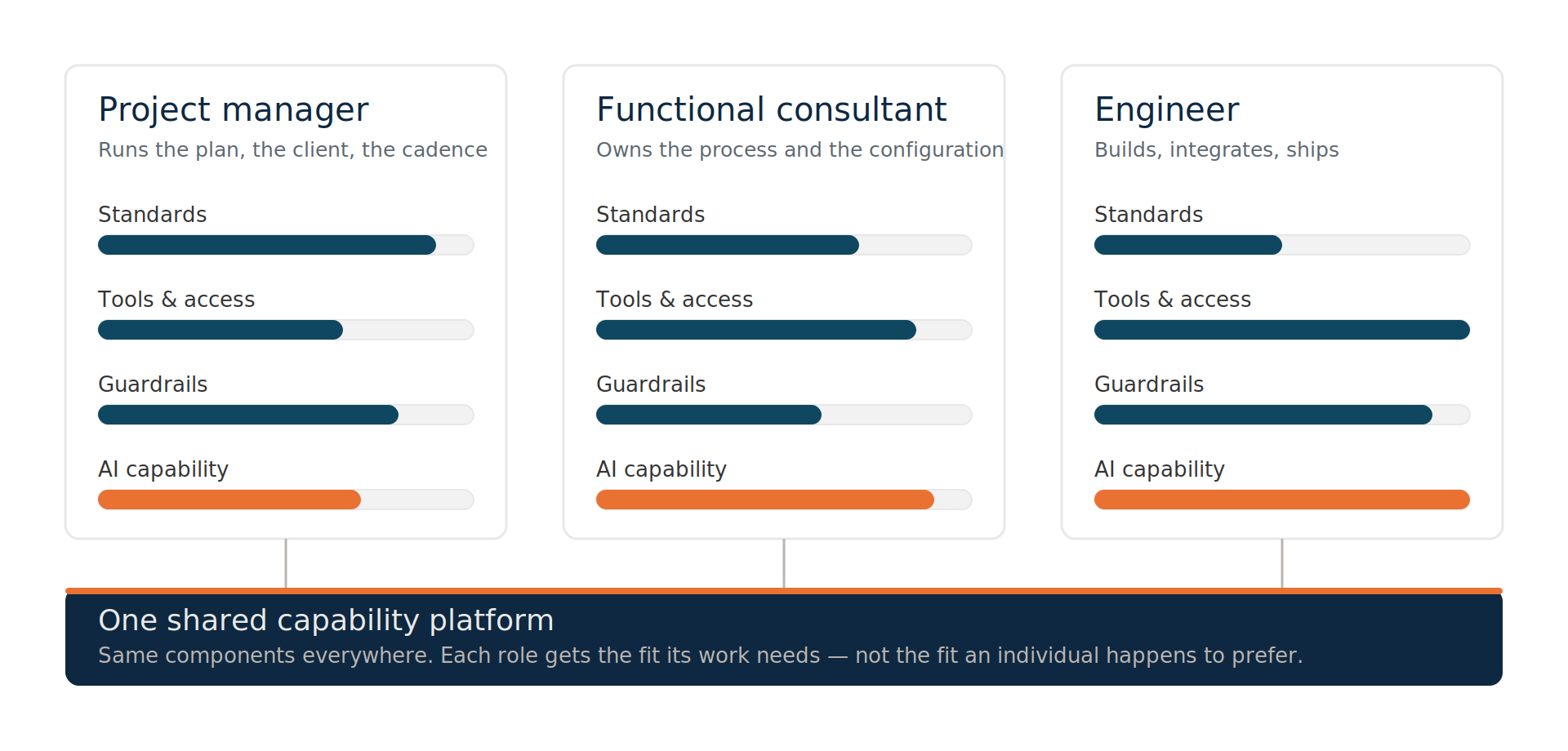
What a project manager’s harness includes
- A weekly client status report that leaves the building meeting the standard, without a partner rewriting it first
- Change requests drafted from a meeting, in the client's contract language, ready for review the same day
- A clear line between what the PM releases on their own and what gets a second look — and a plan to widen it as rework falls
Output should follow the role, not whoever happens to be an AI native
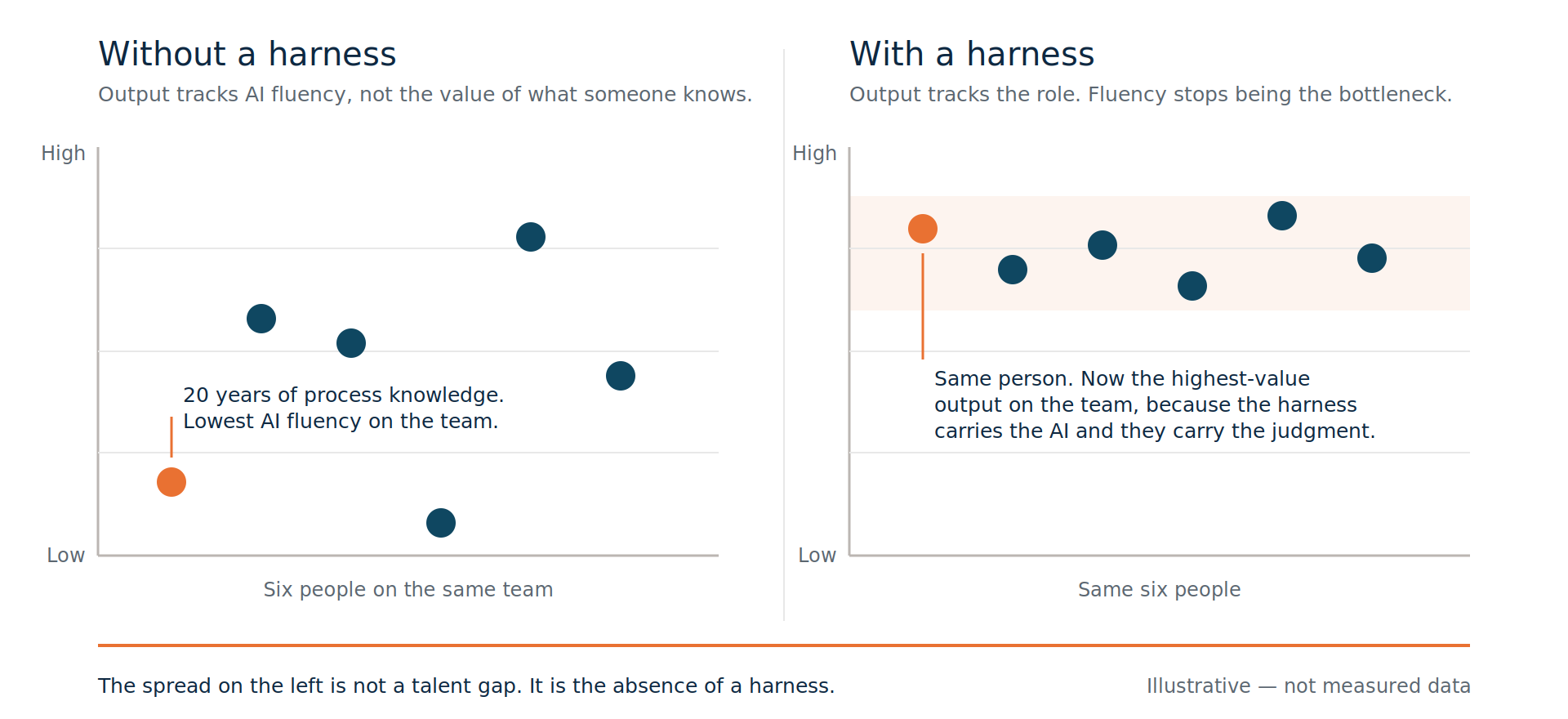
Put the same AI tools in front of six people and you get six different results — not because of talent, but because of how comfortable each person is experimenting. That spread is the problem. The people with the deepest institutional knowledge are frequently the least inclined to tinker, so the most valuable judgment on the team ends up with the least leverage.
A harness removes fluency as the bottleneck. The harness carries the AI. The person carries the judgment. The veteran who knows every exception in your order-to-cash process becomes the highest-value producer on the team, not the one everyone routes around.
You cannot run AI on knowledge you just laid off
Every enterprise sits on a store of process knowledge that has never been written down: why the tolerance is set where it is, which customer needs the manual override, what actually happens at month-end. That knowledge is raw ore. It only becomes gold when it is refined into standards, checks, and repeatable output — and the people who hold it are the only ones who can refine it.
Staff augmentation with your existing team means exactly that: augment the people who hold the ore instead of replacing them with people who don’t.
“The cheapest AI strategy in the building is the twenty-year veteran with a harness.”
Assess, design, install, coach
This is a management-level engagement, not a software rollout. We work with leadership to map roles and the work each produces, design a harness per role, install it into real work rather than a sandbox, and coach the team through the first ninety days until it runs without us in the room.
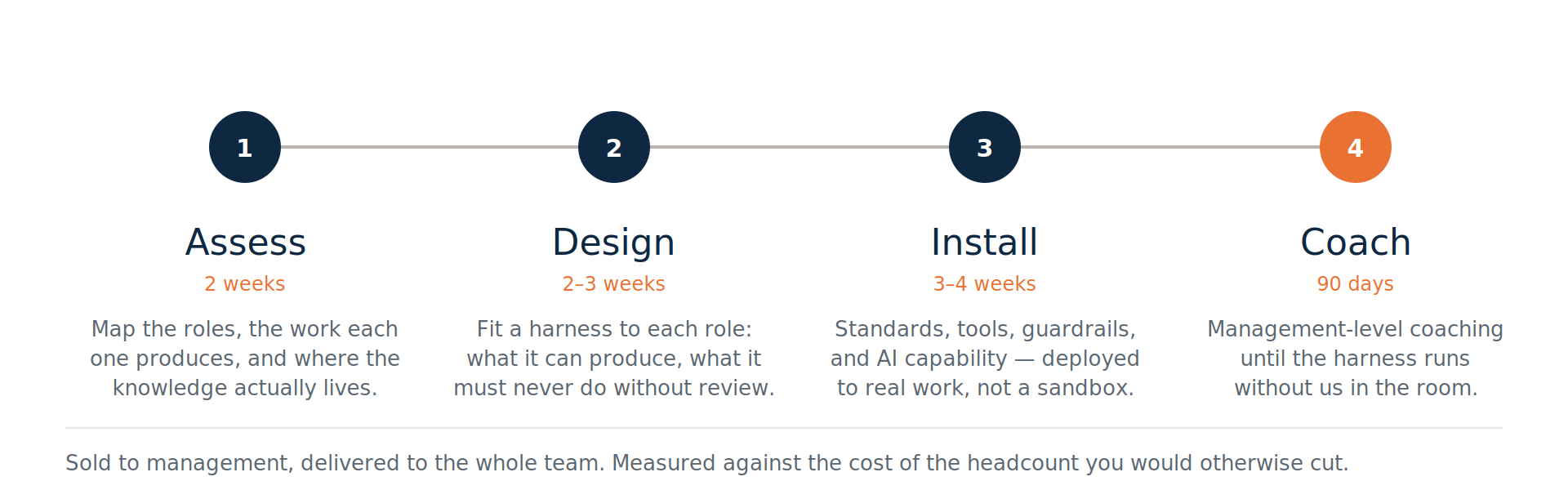
Priced against the cost of the headcount you would otherwise cut.
We built it for ourselves first
deBCor Engineering runs Senior-Led, Global Delivery across the US and India with a compact core team, ranked #5 in the USA among SAP Gold Partners on SAP PartnerFinder. We had the same problem our clients have — deep specialists, finite hours, and a market moving faster than any hiring plan — so we built the harness for our own roles before we offered it to anyone else. We are measuring the results on our own team now and will publish them here.

Fund Approved Partner for AI Enablement with SAP
The harness lifts what your team produces. When the AI belongs inside the SAP systems themselves — agents, Joule, engineering built AI-native from the start — that work runs under DEBCOR Damascus. Same team, same standards, either side of the line.
Questions
What is a workforce harness?
A workforce harness is a role-based operating layer that gives every role on a team the standards, tools, guardrails, and AI capability its work needs — so output depends on the role, not on how AI-fluent any one person happens to be.
Is this a way to replace staff?
No. It is the opposite. The harness exists so companies can get substantially more output from their existing people instead of cutting them and losing the institutional knowledge that made the company work.
Do we need new software?
Usually not. Most organizations already have the AI tools. What they lack is the harness — the role-specific fit, standards, and guardrails that turn tools into reliable output.
What if some of our people don't want to use AI?
That is the situation the harness is designed for. It carries the AI so the person can carry the judgment. Adoption stops depending on individual enthusiasm.
How long does it take?
Assessment runs about two weeks. Design and install run six to seven weeks. We coach through the first ninety days.
Who is this for?
Leadership teams at mid-market and enterprise companies — typically with an SAP landscape — who want AI leverage without a headcount reduction. Sold to management, delivered to the whole team.
Start with an assessment
Two weeks. We map your roles, the work each one produces, and where the knowledge actually lives. You get a harness design you can act on whether or not you engage us to install it.